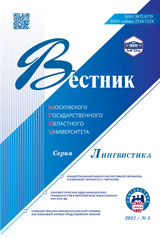
"Key Issues of Contemporary Linguistics" is included in the list of leading academic journals recommended by the Higher Attestation Commission for publishing the results of dissertations for the following scientific specialties:
5.9.6. Languages of the Peoples of Foreign Countries (Germanic and Romance) (philological sciences),
5.9.8 Theoretical, Applied and Comparative Linguistics (philological sciences).
Academic articles and reports, discussion materials, information about scientific conferences play the main role in the journal. The journal publishes the results of scientific research of domestic and foreign scientists in the field of language theory, German studies, Romance studies, comparative-historical, typological and comparative linguistics, theory and practice of translation, intercultural communication. It reflects the discussion of topical issues of linguistics and its practice. The journal promotes expansion of the communicative space of interaction between Russian and foreign researchers. The materials published in it attract attention to the most relevant, promising and interesting areas of linguistics. The journal serves as a platform for exchange of opinions of leading experts in the field of linguistics. It informs specialists and general public about the life of the international and national scientific community: congresses, conferences, publications of monographs, lectures courses and textbooks. The target audience of the journal: linguists, university lecturers, post-graduate students, research teachers, translators.
Current issue
THEORETICAL, APPLIED AND COMPARATIVE LINGUISTICS
Aim. This study investigates discourse-level interference in the English-Korean language pair, with a specific focus on the South Korean variant of the Korean language.
Methodology. To compare the density of English borrowings and insertions within the morphosyntactic framework of Korean across different discourse types, we analyzed texts from various domains. These included fashion and beauty magazines (Marie Claire Korea, Vogue Korea, Cosmopolitan Korea, Harper’s Bazaar Korea, and Elle Korea), information and communication technology (ICT) texts (comprising two master's theses and one scientific article), and news broadcasts (YTN, KBS, and SBS). Additionally, we analyzed contemporary Korean literary works by authors such as Kim Hoyeon, Lee Ki-ho, Song Chi-hyun, Jang Ryu-jin, and Song Seok-che. To examine code-switching in television advertising, musical discourse, and film, we selected and studied 100 Korean commercials from TVCF, South Korea's largest advertising portal. We also analyzed the script of the TV series Sky Castle, the Korean Film Council database, and a corpus of 112 K-pop song lyrics by groups including Aespa, NewJeans, ITZY, Stray Kids, Babymonster, Zerobaseone, RIIZE, and ILLIT.
Results. Analysis of the Korean linguistic material revealed significant English interference at the discourse level. This phenomenon was characterized by the retention of the Korean morphosyntactic framework, an increase in borrowings and insertions from English (leading to the formation of new sub-styles), and a spread of code-switching in specific discourse types. This increase was most pronounced in fashion and beauty discourse, where English lexemes accounted for an average of 12% of the vocabulary. K-pop, a dominant genre of Korean popular music, was found to be almost entirely based on code-switching between English and Korean, with English comprising 79.5% of the lyrical content on average, indicating the formation of a distinct multilingual discourse.
Research implications. This study provides a comprehensive analysis of a substantial body of linguistic data to identify manifestations of interference at the discursive level in the English-Korean language pair. The findings offer a more complete understanding of English-induced interference in contemporary Korean.
Aim. This article aims to analyze Russian scientific and biological discourse in order to determine the set of the FAMILY concept features that are realized in this type of discourse. This will help to determine the content of scientific and biological layer of conceptual category united by the corresponding categorical concept.
Methodology. The methods of conceptual and lexicographic analysis were used. The possible subcategorical concepts were verified to determine whether they are included in the conceptual category under consideration.
Results. Based on the material of biological dictionaries, encyclopedias, and scientific articles features of the concept FAMILY were identified in the Russian linguistic culture. These data allowed to identify the conceptual content of the category under consideration.
Research implications . Methodology for constructing a conceptual category has been proposed. The content of the conceptual category FAMILY has been identified.
Aim. To develop a database structure for determining connotative characteristics of news text.
Methodology. The key research methods are modeling, experimentation, and the author’s method of professionally oriented programming. The procedure includes design, writing, and debugging the programming code.
Results. Experimental software for constructing three databases was developed. Using German news texts, an experiment was successfully conducted to collect news feeds, construct databases of potentially connotative phrases, mark them with numerical markers, and optimize them.
Research implications. The study expands the methodological basis of applied linguistics and also makes it possible to use the created algorithms for the construction and author’s markup of databases for their application in software systems for determining the connotative characteristics of given news flows.
Aim. To determine the set of translational transformations that influence the realization of evidential meanings when transferring the conclusive from Bulgarian to Russian.
Methodology. To achieve the research goals, a bilingual corpus of literary texts is created. Using a frequency dictionary, ten of the most commonly used verbs in the Bulgarian language are identified. Conclusive word forms of the aforementioned verbs and their equivalents in Russian are found and analyzed.
Results. The role of translation transformations in the process of realizing evidential meanings is identified. Key factors contributing to the emergence of specific evidential meanings are determined.
Research implications. The presented results can be used for further research on the transferring of evidential meanings in the Bulgarian-Russian language pair.
Aim. To identify and model the systemic divergence of coherence strategies in English and Russian academic discourse within the Systemic Functional Linguistics framework, and to formalize the Principle of Lexico-Syntactic Compensation.
Methodology. A balanced tripartite corpus of 1.3 million words was analyzed, consisting of original articles from high-impact journals (Scopus/WoS and VAK) and parallel professional translations. The study employed automated marker extraction with rigorous manual validation using Cohen’s kappa coefficient (к = 0.89), calculation of lexical diversity via Standardised Type-Token Ratio (STTR), and the Log-likelihood statistical test.
Results. The analysis revealed that English discourse relies on a Syntactic Explicitness Strategy (high frequency of discourse markers), whereas Russian discourse favors a Lexical Compensation Strategy (high lexical variation). It was established that translators intuitively compensate for syntactic deficits using lexical means.
Research implications. The concept of register-specific "rhetorical grammars" is substantiated. The practical significance lies in the model's applicability for evaluating and fine-tuning Natural Language Processing (NLP) systems and improving specialized translation quality.
Aim. To reveal and describe the specific features of the linguocognitive strategies of metamemory in commemorative discourse.
Methodology. Having analyzed 800 English-language commemorative internet texts, the author builds an integrative linguocognitive model of the commemorative act as a unit of mnemic behavior, following the TOTE scheme. General scientific methods (description, observation, etc.), types of analysis of language phenomena (conceptual, linguopragmatic, linguostylistic, discourse analyses) and linguocognitive modeling were used.
Results. It has been found that the commemorative act follows the stages of the mnemic cycle in reverse order: reproduction, preservation, memorization. For each stage the author reveals and systematizes the linguocognitive strategies of the key memory management processes of monitoring and control.
Research implications. The study suggests a methodology of linguocognitive analysis of the commemorative act with a focus on the dynamic aspect of memory. The methodology is applicable in cognitive linguistics and linguopragmatics to analyze mechanisms of speech impact through the collective memory in institutional discourse. The findings can be used in the theory and practice of speechwriting for commemorative texts and to conduct linguistic expertise of political rhetoric.
Aim. The primary objective of this study is to analyze the specific usage of the term "facilities" in Englishand Chinese-language academic discourse and propose translation methods that account for its polysemy and contextual variability.
Methodology. The study's materials include English-language academic articles, Chinese publications, and institutional texts. Methods of comparative linguistic analysis, corpus sampling, and discourse description were used.
Results. It was revealed that in the English academic tradition, "facilities" encompasses a wide range of meanings: infrastructure, platforms, services, and research conditions. In Chinese texts, the term's meaning is often reduced to the variants "设施" and "设备," which leads to a narrowing of the semantic field and a distortion of the functional role. An analysis of the examples revealed typical errors associated with the reduction of institutional and service components.
Research implications. The theoretical significance of this work lies in clarifying concepts regarding the translation of polysemous terms and the role of discursive factors. The practical value lies in the development of recommendations that can improve the quality of academic texts and facilitate their integration into the international scientific community.
LANGUAGES OF THE PEOPLES OF FOREIGN COUNTRIES
Aim: to describe political narratives in the public discourse of Salvadoran President Nayib Bukele from a linguopragmatic perspective based on his official speeches from February 3, 2019 to August 12, 2025.
Methodology. The main research method is critical discourse-analysis (CDA), which helps to analyse the discourse of the Salvadoran president as a powerful tool for influencing the consciousness and behavior of the electorate. It is also based on general scientific and linguistic methods, such as interpretation, induction, contextual, conceptual and linguostylistic analysis.
Results. The undertaken research allows us to conclude that N. Bukele’s public discourse is highly emotional and politically engaged. In his speeches, delivered to national and international audiences, we can perceive an extremely positive image of the country and its president, which is created with the help of three types of political narratives: a) El Salvador is a free and safe country; b) El Salvador is an advanced country; and c) El Salvador is a prosper country. These ideas are represented by metaphors, lexical repetitions, ideologemes, and direct and indirect appeals.
Research implications. The theoretical significance of the study lies in the fact that it resulted in a deeper understanding of Latin American populism and the main ways of its linguistic representation. The results can be used in a further investigation of Latin American political discourse based on public speeches of other leaders. They can be also used in the framework of such disciplines as Linguistics, Political Sciences and Area Studies.
Aim is to analyze the semantic and structural peculiarities of religious-literary texts in the context of the category of sacredness.
Methodology. The study is based on the theoretical data of dominant, intertextuality and categorial text modeling, with lingua-stylistic, emotive, definitional, and contextual analyses being employed.
Results. Described the mechanisms of religious-literary text formation and proposed the algorithm of language means analysis. Shown that the Names of God are linguistic representatives of sacred knowledge in the text under study. Imagery is viewed as a vehicle of poetic knowledge conceptualizing sacredness and the poetic detail is treated as instrumental in effecting linguistic analysis. Established usual / occasional semantic correlations of language means representing two types of knowledge and structuring the text.
Research implications . The results obtained develop the theories of text formation and text typology. Accentuated the mechanism of text formation at the intersection of two knowledge types and linguistic framework of gnoseologically heterogeneous texts. Proposed the new solution to the problem of religious and linguistic categories interaction in the process of text production.
Aim. Developing a new understanding of invective game based on materials from the English-language film dialogue.
Methodology. Contextual analysis is used to identify the speaker's communicative intentions and attitudes. Processes of neutralization of potentially offensive (invective) language are examined within a speech situation.
Results. It is found that communicators use invective game to create a unifying communicative space and convey information about a positive assessment of the recipient. The influence of elements such as the inclusion of cooperative nonverbal cues, the presence of a basis for invective usage (verbal or nonverbal action), and the absence of additional participants in the communication is examined.
Research implications. It is proposed to use the term “invective game” when analyzing a speech situation. Information on the cooperative potential of invective in English has been updated.
SCIENTIFIC LIFE

ISSN 2949-5075 (Online)